



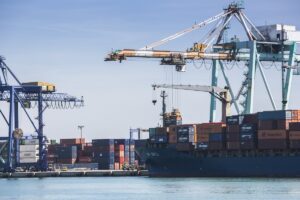
- Valenciaport handled 2,317,507 TEUs through May, up 0.17% from the same period in 2025; year-over-year, container traffic totalled 5,666,554 TEUs (+2.13%)
- During the month of May, the facilities in Valencia, Sagunto, and Gandia handled 7,050,430 metric tons (-4.17%) and 504,061 containers (-0.19%)
- Rail traffic increased by 19.34% in metric tons, and automobile traffic grew by 9.95%, with 225,435 units transported between January and May
- Sagunto has seen a 5.59% increase in traffic so far this year, driven by liquid bulk cargo and automobiles
Valencia, June 17, 2026 – The Port Authority of Valencia (APV) handled 32.8 million metric tons during the first five months of the year, representing a 3.59% decrease compared to the same period last year, driven by a decline in solid bulk cargo, particularly construction materials, which fell by nearly 60%. Despite this decline, container traffic remained steady at 2,317,507 TEUs, up 0.17% from 2025.
Data from the Valenciaport Statistics Office show that, during the month of May, the facilities in Valencia, Sagunto, and Gandia handled 7,050,430 metric tons of cargo (-4.17%) and 504,061 containers (-0.19%). On a year-over-year basis—covering the last twelve months—Valenciaport handled 78.8 million metric tons (-2.22%) and 5.66 million TEUs (+2.13%).
Solid bulk cargoes totalled 1.1 million metric tons in the first five months of 2026, representing a decrease of -8.15%. The most significant declines were seen in cement and clinker (-50.9%), potash for fertilizer (-48.35%), and non-metallic minerals (-45.52%); meanwhile, chemical products grew by over +31.31%, along with fertilizers (+13.61%). Liquid bulk cargoes increased by +12.3% to 1.6 million metric tons, driven primarily by energy products (crude oil, fuel oil, diesel, gasoline, etc.), which grew by +24.54%
By port, Sagunto has shown positive year-to-date growth, with 3,449,800 metric tons, up 5.59%, driven by growth in liquid bulk (+20.65%) and automobiles (+20.39%). Gandia, for its part, reached 142,202 metric tons, an increase of 57.82%.
Imports exceed exports
Traffic figures show a mixed trend between exports and imports. Cumulative cargo (exports) stands at 9.9 million metric tons (-4.12%), while unloading (imports) rose to +10.6 million metric tons (+6.77%). In terms of containers, TEUs loaded for export fell by -2% to 367,640 units, while those unloaded grew by +10.87% to 461,175 containers.
In terms of the form in which the cargo is handled, liquid bulk cargo totalled 1,883,368 metric tons, representing a +0.38% increase. Provisions also increased (+16.70%) as did fish (+29.40%), while containerized general cargo totalled 23.18 million metric tons (-5.19%).
China strengthens its trade leadership
China remains Valenciaport’s main trading partner. Through May, trade with China totalled 4,195,649 metric tons, up 25.80%, and 385,738 full TEUs, representing a 26.45% increase.
The United States ranks second in full container traffic, with 139,335 TEUs, although it recorded a decline of -13.31%. It is followed by Algeria, with 127,775 TEUs (-5.94%); Spain, with 88,475 TEUs (+0.50%); and Turkey, with 80,781 TEUs (-23.98%).
Automobiles and railroads are on the rise
Car traffic continues an upward trend. Between January and May, Valenciaport handled 225,435 vehicles, a 9.95% increase over the same period last year. In May, car traffic totaled 51,277 units, representing a monthly increase of 10.48%.
Rail traffic is also growing strongly, totalling 1,609,840 metric tons, a 19.34% increase, and 120,698 TEUs, up 17.57%. These figures reinforce the role of rail in Valenciaport’s intermodal and land connectivity strategy.
The number of scheduled-service passengers continues to rise
Passenger traffic reached a cumulative total of 456,189 people through May, an 8.07% decrease compared to the same period in 2025. This trend is driven by a decline in cruise passengers, which stand at 181,928 (-18.77%), while regular ferry services saw a slight increase to 274,261 passengers (+0.74%). In May, Valenciaport recorded 125,935 passengers, a 17.03% decrease compared to May 2025. However, on a year-on-year basis, total passenger traffic reached 1,620,770 people, representing a positive variation of 0.58%.