



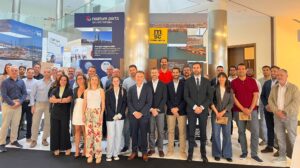
- The Port Authority of Valencia held a technical seminar today, on World Environment Day, titled “Energy Self-Sufficiency in Ports”
- This meeting addressed renewable energy generation, energy storage, smart energy management, and local production of low-carbon fuels
- The event was attended by representatives from the APV, technology companies, and specialized organizations such as Bluenewables, Rotary Wave, KLIUX-Online, ITE, Ceteck, Tergy Sagava, and ARIEMA
Valencia, June 5, 2026 – How to generate more renewable energy within the port area itself, how to store it efficiently, and how to advance the use of low-carbon fuels were among the issues discussed today at the Clock Tower during the technical conference “Energy Self-Sufficiency in Ports,” organized by the Port Authority of Valencia (APV), together with the Valenciaport Foundation, to mark World Environment Day.
The event brought together representatives from the port community, technology companies, and specialized organizations to explore solutions that will enable ports to reduce their energy dependence, optimize their energy consumption, and move toward more sustainable and resilient business models that are better equipped to meet the challenges of decarbonization.
Throughout the session, technical presentations, project showcases, and discussion forums were combined, fostering direct interaction among participants and an analysis of the key trends that will shape the future of energy in ports.
The event was opened by Aurelio Acedo Aceña, Executive Director of the APV, and also featured remarks by Esteban Perales Quiles, Head of Energy Transition at the APV.
Energy self-sufficiency: Key to Port Infrastructure
The first session of the day focused on renewable electricity generation in port environments, covering new technologies applicable to ports, including solutions for harnessing energy from the marine environment, wind energy, and ongoing business initiatives.
The first session of the day focused on renewable electricity generation in port environments, covering new technologies applicable to ports, including solutions for harnessing energy from the marine environment, wind energy, and ongoing business initiatives.
Moderated by Santiago López Cánovas, Head of the Environment at the APV, this session featured Cecilio Barahona of Bluenewables; Andrea Novas of Rotary Wave; and Iñaki Eguizábal of KLIUX-Online.
The second session focused on energy storage and energy management systems. Specifically, it addressed tools that optimize energy production, storage, and consumption in port facilities, including practical examples from other ports.
Moderated by Esteban Perales Quiles, Head of Energy Transition at the APV, the session featured presentations by Juan Gilabert Marzal of the Energy Technology Institute (ITE) and Ernesto Bedriña Ramírez of Ceteck.
The third session of the day focused on the local production of low-carbon fuels, a key area for the decarbonization of maritime transport and port operations, during which initiatives related to biogas, renewable hydrogen, and other emerging energy sources were discussed.
Moderated by Aurelio Lázaro Chueca of the Valenciaport Foundation, this session featured presentations by Daniel Soares of Tergy Sagava and Enrique Girón of ARIEMA.
Valenciaport and its progress toward a more self-sufficient energy model
This event is part of Valenciaport’s commitment to a more sustainable, efficient, and self-sufficient energy model. The APV has been promoting various initiatives aimed at increasing renewable energy production within the port area and optimizing its management.
A prime example of this is the solar power installations at the ports of Valencia and Gandia, which make use of available space to generate renewable electricity for the ports’ own consumption. In the case of the Port of Gandia, these installations are further complemented by battery-based energy storage systems, which help improve the management of the energy generated and move toward more efficient and flexible consumption models.
At the same time, the APV is working on new renewable energy projects, including initiatives related to the development of wind turbines in connection with the northern expansion of the Port of Valencia, as well as other innovative energy solutions within the port area.
In addition, an advanced energy management tool is being developed to optimize the monitoring, control, and planning of energy consumption across the entire port system. Such platforms will enable the integration of renewable energy generation, energy storage, and electricity demand, facilitating more efficient and sustainable energy management.
Environment Week
The conference “Energy Self-Sufficiency in Ports” is part of Valenciaport’s Environment Week, which was held in conjunction with World Environment Day. As part of this event, the Clock Building also hosted an exhibition showcasing the main environmental initiatives and projects of the Port Authority of Valencia and companies within the port community.
The exhibition has provided the port community and the general public with insight into some of the initiatives currently underway in the areas of sustainability, energy efficiency, energy conservation, and the use of alternative energy sources. In addition, to coincide with this event, the APV has released aerial images of the project completed at the Port of Gandia, which was funded by Next Generation EU funds and carried out under the Spanish Government’s Recovery, Transformation, and Resilience Plan. With an investment of 1.4 million euros, the project has generated 745 kilowatts of power, making it Spain’s first self-sufficient port.