



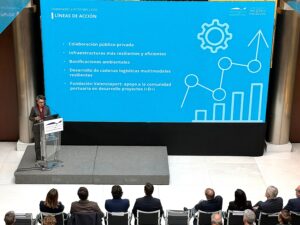
- The Port Authority of Valencia has presented its Net Zero Emissions plan, aiming to achieve carbon neutrality in the ports of Valencia, Sagunto and Gandia
- This plan is part of the Valenciaport 2035 Strategy, with which the institution ratifies its commitment to sustainability and energy transition
- The plan has an investment of 900 million euros – planned or already implemented – of which 605 million are contributed by the APV and 295 million come from private investment
Valencia, 4th of December 2025 – Valenciaport aims to achieve carbon neutrality at its facilities in Valencia, Sagunt and Gandia by 2035. Within this timeframe, it also expects to achieve energy self-sufficiency, being able to produce all the energy it needs to meet the consumption associated with the economic and commercial activity of the various ports.
This is set out in the Net Zero Emissions Plan presented by the president of the Port Authority of Valencia (APV), Mar Chao, who stressed that this document will serve as the roadmap for the Port Authority to lead the entire decarbonisation process for the port community as a whole, involving shipping companies, terminal operators, land transport and port services, among others.
The plan, which has an investment (planned or already underway) of €900 million, of which €605 million come from the APV and €295 million from private investment, is based on the principles of ‘resilience, efficiency and protection’ – highlighted the president, who reaffirmed the APV’s commitment to reducing the consumption of hydrocarbons and fossil fuels in favour of other less polluting energy sources with greater capacity.
Valenciaport has been promoting environmental policies for nearly 30 years, starting in 1998 with the ECOPORT project, and today ‘sustainability is one of the fundamental pillars of our strategy’ – said the president. She explained that ‘Electrification, efficiency and self-sufficiency’ are the criteria that run through the different actions of Net Zero Emissions.
In this regard, the plan includes actions such as the construction of two new substations in the Port of Valencia, which will be operational between 2026 and 2028, and the provision of charging points (OPS) for ships at the various terminals. Likewise, throughout 2027, an intelligent energy management system based on the application of digital twins will be implemented.
Energy self-sufficiency
The aim of these actions is to make Valenciaport self-sufficient energy-wise by 2035. Currently, 18% of the energy consumed is already produced thanks to photovoltaic installations at various points in the ports of Valencia, Sagunt and Gandia. The first step towards increasing this amount will be the installation of three wind turbines, which, together with the solar plants already in operation, will enable 51% of the energy consumed to be supplied.
In terms of self-sufficiency, the plan also envisages the launch of a new energy storage system in the Port of Gandia, with a capacity of 1 MW, which will consolidate its position as the first European port with the capacity to produce all the energy it consumes. This project will be operational throughout 2028, together with two pilot energy projects of 270 kW and 1 MW, respectively.
Electric vehicles, electrification of facilities and shore-side electricity supply (OPS). New fuels
The plan also includes the use of electric vehicles and the electrification of facilities and terminals. Similarly, it is expected that by the end of 2028, a total of eight berths for supplying electricity to ships (OPS) will be operational, of which 10 must be electrified in accordance with current international regulations, representing 80% of total demand. This figure will bring the APV very close to the mandatory target set for 2030, whereby at least 90% of the annual demand for container and passenger ship calls must be met.
Similarly, in conjunction with the Valenciaport Foundation, work is being carried out very actively on testing different alternative fuels (hydrogen, methanol, and biofuels) for both port machinery and vessels.
Adaptation to climate change
The Net Zero Emissions Plan also includes a climate change adaptation plan, which seeks to increase the resilience of the ports of Valencia, Sagunto and Gandia; work within the strategic framework set by Puerto del Estado to create eco-proactive ports; and update the risks that may arise from waves, heavy rain, heat waves or sea level changes.
The aim of this plan is to ‘identify the critical risks for each port; establish specific adaptation measures, prioritising key areas such as quays, docks, terminals, accesses and terminal operations; and always do so under a process of continuous monitoring and improvement,’ explained the president.
Strategic objective
The president stressed that all these actions are part of the Valenciaport Strategic Plan. ‘This strategy is our roadmap for leading the decarbonisation of the ports of Valencia, Sagunto and Gandía through the implementation of action plans defined for each subsector of the Valenciaport port community.’ In her opinion, this work must be carried out through public-private collaboration, the construction of more resilient and efficient infrastructure, a commitment to environmental subsidies and the development of resilient multimodal chains with which to provide the best service to our customers.