



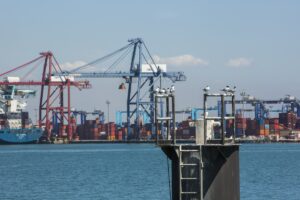
- The adaptation of the ports of Valencia, Gandia, and Sagunto to climate change is part of the Net Zero Emissions Plan
- The aim is to create eco-proactive ports and assess the risks posed by rough seas, heavy rain or heatwaves
- Priority will be given to key areas such as quays, docks, terminals, access points and terminal operations
Valencia, March 24th, 2026 – The Port Authority of Valencia (APV) has begun work on a plan to adapt the facilities in Valencia, Sagunto and Gandia to climate change, with the aim of increasing their resilience. This work forms part of the Net Zero Emissions Plan, through which Valenciaport is spearheading all sustainability policies within the port area.
The goal is to create eco-proactive ports and to assess the risks posed by rough seas, heavy rain, heatwaves or changes in sea level. Accordingly, Valenciaport has already begun work in line with the provisions set out by Puertos del Estado in its Strategic Framework for the Port System of General Interest, according to which all state-owned ports must have implemented these adaptations by 2030.
The tasks involved in preparing this plan have a completion period of 14 months. The work involved in drawing up this plan has a completion period of 14 months and has been awarded to the company Ineco for €181,229.35 (excluding VAT). Work is underway to identify the critical risks at each port; to establish specific adaptation measures, prioritising key areas such as quays, breakwaters, terminals, access points and terminal operations; and to ensure this is always carried out with a focus on monitoring and continuous improvement.
This plan will be based on an analysis of the vulnerability of the three ports, an assessment of the risks posed by extreme weather events, and a proposal for measures to be taken to deal with such situations. These measures must consider all possible impacts of extreme weather events and the resilience of the infrastructure and services provided at these locations.
They must also prioritise the infrastructure and services that are most vulnerable, and must, as a minimum, be based on the general adaptation measures set out in the adaptation strategies drawn up by the APV. The proposed priority solutions must include a cost-benefit analysis to assess the economic viability of the proposed adaptation measures.
The Net Zero Emissions Plan
The development of these climate change adaptation plans forms part of APV’s Net Zero Emissions Plan, which aims to achieve carbon neutrality at Valenciaport’s facilities by 2035. By this date, it is also expected to have achieved energy self-sufficiency, being able to produce all the energy required to meet the energy needs associated with the economic and commercial activities of the various ports.
This document serves as the roadmap by which the Port Authority will lead the entire decarbonisation process for the port community, involving shipping companies, terminal operators, land transport providers and port services, amongst others. In this regard, the plan includes measures such as the construction of two new substations at the Port of Valencia, which are due to become operational between 2026 and 2028, and the provision of shore power supply points (OPS) for ships at the various terminals. Furthermore, a smart energy management system based on the use of digital twins will be rolled out throughout 2027.