



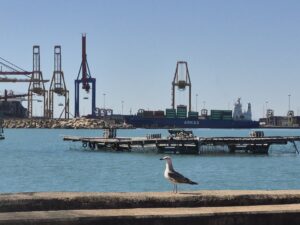
- The 38 companies that make up the Ecoport II group have reported on the environmental targets they set for 2025
- Fuel consumption has been reduced by over 5% respresenting a saving of 6.3 million litres
- The electrification of the vehicle fleet, the installation of solar panels and environmental training have been some of the initiatives carried out
Valencia, April 10, 2026 – The reduction of fuel consumption, as well as water and electricity use, has been at the core of the main environmental actions undertaken by companies in the port community throughout 2025. Companies within the Ecoport II group, led by Valenciaport, have also worked to promote the use of alternative energy sources, including solar panels, photovoltaic energy, and the use of vegetable oils (HVO), among others.
The Ecoport II group is made up of 38 companies from the port community, whose aim is to work towards improving the environmental performance of the ports of Sagunto, València and Gandia. In this regard, last year they voluntarily set nine environmental objectives and made a commitment to training initiatives, going beyond the requirements of their own environmental management systems.
The results obtained demonstrate both qualitative and quantitative improvements in the state of the environment across the ports managed by the Valencia Port Authority (APV).
Among the objectives undertaken, the reduction of fuel consumption by 1% stands out. This commitment was adopted by eleven companies, which achieved savings well above the initial target, with an estimated average reduction of 5.6% per company, representing a total of 6,302,621 litres. Likewise, six of the eleven companies that took on this challenge achieved an average reduction in electricity consumption of 5%.
The reduction of water consumption by 1% was another of the commitments set, accepted by eleven companies, eight of which managed to reduce their water use by approximately 29.2%, equivalent to 76,550 litres. Meanwhile, ten companies committed to measuring their carbon footprint, of which 80% successfully did so, while 16 met the target of participating in environmental initiatives.
The commitment to alternative energy sources
A total of eight companies committed to improving the use of alternative energy sources. To this end, they implemented measures such as replacing conventional fuels with alternative ones, installing solar panels on a catamaran, using HVO as an alternative fuel, deploying photovoltaic plants and energy storage systems, charging electric vehicles, upgrading LED lighting, obtaining renewable energy certification, and incorporating electric tractor units.
Likewise, eight companies set the objective of increasing the percentage of waste that is recovered. Five of them achieved this goal, with an average increase of 33% across the companies, equivalent to 99,101 kilos. Meanwhile, three other firms committed to developing actions aimed at adapting to climate change, and all of them successfully met the target they had set.
Finally, a total of five companies committed to and achieved the objective related to circular economy identification. In this regard, the following actions were carried out: reforestation, the reuse of plastics, and the use of wastewater from new vehicle washing facilities for cleaning yards, as well as participation in fuel recovery processes, including the storage of waste and fuel once it has been recovered.
Commitment to training and awareness-raising
During 2025, the companies within Ecoport II also committed to environmental training and awareness-raising. As a result, a total of 2,300 person-hours were devoted to training across the workforce of all participating companies.
In addition, the companies established as environmental commitments a self-assessment of the SDGs for each company, including their identification and specific actions. Among the 17 Sustainable Development Goals, those most commonly selected by the majority of companies were: Affordable and Clean Energy; Decent Work and Economic Growth; Industry, Innovation and Infrastructure; Responsible Consumption and Production; and Climate Action.
The specific actions included, among others, reducing fuel consumption, fleet electrification and the replacement of vehicles with electric ones, the installation of solar panels, energy storage batteries, and internal environmental training initiatives, among others.
Ecoport II Companies The companies that make up the Ecoport II group are: Agromerchants, Amarradores del Puerto de Valencia, S.L., APM Terminals Valencia, Valencia Port Authority, Baleària Eurolineas Marítimas, S.A., Centro Portuario de Empleo de Valencia, S.A., Docks, Logística Chema Ballester, COSCO SHIPPING Lines (Spain) S.A., MOEVE, Fertiberia, S.A., Fundación Valenciaport, Galp Energía España, S.A.U., Garbaport, Infoport, Intersagunto Terminales, S.A., ID Logistics Iberia, MSC Terminal Valencia, S.A., Mundo Marino, Noatum Terminal Sagunto, CSP Iberian Valencia Terminal S.A.U., Portuaria Levantina, S.A. (PORLESA), Prácticos de Valencia, Refit & Repair Valencia SL, Remolcadores Boluda, S.A., Planta de Regasificación de Sagunto, S.A. (SAGGAS), Infraportva S.L.U., Real Club Náutico de Valencia, Terminales Portuarias, S.L. (Tepsa), Transportes Remedios Torres, S.L., Seroil-Reciclamas, Sertego Puerto de Valencia, Servmar Balear, Toyota Logistic Services España, S.L., Trasmed, Valencia Terminal Europa S.A. (VTE), Vareser96, S.L., and Velas Lluch.