



-
ECOPORT II is the European initiative with which Valenciaport works to consolidate an environmentally friendly port community.
-
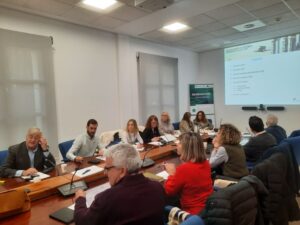
The ECOPORT II working group has met to take stock of the actions implemented in 2025 and the forecast for the coming years.
-
The installation of renewable energy sources and electric charging points for ships are the focus of future projects, within the framework of Valenciaport’s Net Zero Emissions plan.
Valencia, 29 December 2025 – ECOPORT II, Valenciaport’s project to consolidate an environmentally friendly port community, has set itself the objectives of developing renewable energy sources and installing electric charging points for ships, in line with Valenciaport’s Net Zero Emissions plan, which aims to achieve carbon neutrality at its facilities in Valencia, Sagunt and Gandia by 2035.
Within this period, it is also expected to achieve energy self-sufficiency, being able to produce all the energy it needs to meet the consumption associated with the economic and commercial activity of the various ports. The plan envisages an investment of €900 million, of which €605 million will come from the Port Authority of Valencia and €295 million from private investment.
The projects included in the Net Zero Emissions plan were the focus of the ECOPORT II working group meeting, which also took stock of the actions carried out during 2025 and addressed the challenges and projects to be tackled in the future.
Among the planned actions are the provision of charging points (OPS) for ships at the various terminals, together with various measures aimed at making Valenciaport energy self-sufficient by 2035. Currently, 18% of the energy consumed is already produced thanks to photovoltaic installations at various points in the ports of Valencia, Sagunt and Gandia.
ECOPORT II, nearly 30 years of environmental policies
Valenciaport has been promoting environmental policies for nearly 30 years through ECOPORT. The project has 38 member companies working to develop and evolve a methodology for implementing environmental management systems in ports and the hubs that form their community.
The working day served to learn about projects such as the CLEVER TOOL, created within the framework of the ARSINOE project to support the APV in the Climate Change Observatory. The presentation was given by Noemi Monterde, Senior Project Manager at the Valenciaport Foundation.
Attendees were also informed about the NeXTraIn.PortS project, which focuses on training mobility in Valencia, Rotterdam, Livorno, and Piraeus. This initiative took place in Venice in November 2025 and was also presented at the meeting by Noemi Monterde.
For her part, the Head of Sustainability and Good Governance at KPMG in the Valencian Community and the Region of Murcia, Noelia Martínez, explained how Environmental Management Systems are integrated into Sustainability Information Management Systems through the Ecoport Project, and also addressed the monetisation of energy savings through Energy Savings Certificates (ESC).