



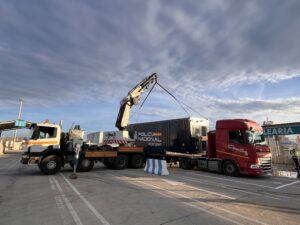
- The container arrived at 8 o’clock this morning at the Port of Valencia facilities
- The Port Authority of Valencia project is 75 % co-financed by the European Union through the European Funds for Internal Security
- The project, with a total cost of €584,767.59 (including VAT), aims to support the National Police in managing travellers and checking identities

Valencia, January 29th, 2026– Valenciaport has taken a new step towards the launch of the project aimed at creating a support point for the Ministry of Interior in border control, with the arrival of the container where the equipment will be installed. The container arrived at 8 a.m. at the Port of Valencia facilities, and works have begun installing the control equipment.
This project, with a budget of €584,767.59 (including VAT), is co-financed by the European Union through the European Internal Security Fund (EISF) and seeks to strengthen border security at the ports of Valencia and Sagunto.
These new facilities enable improved management of external borders, ease the management of migration flows, and prevent, detect and investigate actions related to terrorism and other serious crimes.
The container installed at the Port of Valencia will house this equipment. The infrastructure has large windows, thermal insulation, lighting, furniture, and state-of-the-art technology for reading passports and assisting travellers. In addition, the facility is equipped to operate efficiently in identifying verification and immigration control procedures.
Its design ensures efficient and secure operation, allowing identity verification and control procedures to be carried out efficiently and with full guarantee.
The project involves the implementation of the Entry and Exit System (EES) and the European Travel Information and Authorization System (ETIAS). For these matters, the acquisition of verification and monitoring tablets, as well as registration tablets, are planned.
The EES system allows for the recording of entry and exit data, as well as the refusal of access to third-country nationals crossing the external borders of Member States. On the other hand, the ETIAS system is designed to assess whether the presence of these travellers poses a risk to public safety or health, and to manage travel authorization on that basis.
Collaboration with the Ministry of Interior and European institutions
This project responds to the APV’s objective of actively collaborating with the Ministry of Interior and European institutions to improve border controls.
In addition, verification and supervision tablets will be incorporated, which will facilitate the work of the control teams and increase efficiency in border information management.