



- This is one of the conclusions drawn from the conference “Supply chains and ports facing the new global scenario: emerging markets” organized by the Valenciaport Chair of Port Economics.
- The conference brought together university and business experts to analyze the consequences that the new global order is having on supply chains and ports.
- The director of the Chair, Vicente Pallardó, and the head of Economic Analysis at BBVA, Rafael Doménech, were among the speakers who gave keynote speeches.
València, 25th march, 2026 – “The geopolitical tensions following Donald Trump’s arrival on the scene are transforming the world’s major shipping routes, posing a significant challenge for global trade, logistics, and transport.” This was stated by Vicente J. Pallardó López, director of the Valenciaport Chair of Port Economics and director of the Institute of International Economics at the University of Valencia (UV).
He added that “we are seeing a shift in Chinese exports towards developed countries. At the same time, countries that were previously less important are gaining weight, not only in Asia, but also in a process of regionalization that is already noticeable. For example, nations close to Western Europe and some Latin American countries are increasing in importance.”
Pallardó’s conclusions were presented during the conference entitled “Supply chains and ports in the face of the new global scenario: emerging markets,” which was held at the “Edificio del Reloj” (Clock Building) and is part of the activities organized by the Valenciaport Chair of Port Economics at the University of Valencia, funded by the Port Authority of Valencia (APV).
The conference brought together university and business experts to analyze the consequences that the new global order is having on supply chains and the port sector. In this regard, the aim of the conference was to create channels of knowledge, both academic and practical, for the development of activities that are valuable to the port community, companies operating nationally and internationally, and society in general.
Valenciaport faces the US-Iran conflict
Pallardó also pointed out that if the conflict between the United States continues, it will affect port traffic. In this regard, he noted that Valenciaport has not been affected by this situation so far, and has even maintained or improved its traffic, but he warned that the problem could arise, if the conflict continues, due to an increase in oil prices.
For his part, Rafael Doménech Vilariño, Head of Economic Analysis at BBVA Research and Professor of Economic Analysis at the University of Valencia, who also participated in the conference, pointed out the need to “build more Europe” in the face of the current global crisis. “Europe grows with crises,” as seen in situations such as the war in Ukraine, “but we have to see all this as a second best; the first best is to exercise its soft power, the soft power of a market and a global social and political reference in a world based on rules and respect for rules,” he said.
Domenech also pointed out in his speech the risks facing Europe and how Donald Trump’s policies are having global repercussions. In his reflections, he dared to predict an end to the conflict in Ukraine that could involve the cession of Ukrainian territory to Russia and a Ukraine within the EU but outside NATO.
He also pointed out the importance in the future of creating a digital euro to counter the dollar, which has never given up on becoming the currency of world trade.
On the other hand, he has pointed out the importance in the future of creating a digital euro to counter the dollar, which has never given up on becoming the currency of world trade.
Keynote speeches by experts
The event, held at the Edificio del Reloj, included a presentation by Vicente J. Pallardó López entitled “Four years thinking about a transformed world”. Another keynote speech was given by Rafael Doménech Vilariño, who spoke about the global economic outlook in the current environment, which is defined by geostrategy.
The conference also featured a round table discussion entitled ‘New scenario, new challenges, new opportunities,’ with the participation of Damian Kutnowski, CCO MARTICO; Luz Martínez Musoles, Director of the International Department of the Valencia Chamber of Commerce; Jonas Mendes Constante, Senior Consultant for Port Strategy & Innovation at the Valenciaport Foundation; and Bojan Shimbov, researcher at the Institute of International Economics at Jaume I University.
Award ceremony of the Chair
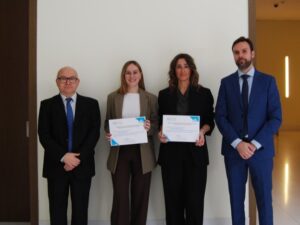
They also presented the Chair’s awards for the best Master’s degree final projects, which were attended by the Vice-Chancellor for Transfer and Innovation at the University of Valencia, Rosa María Donat Beneito, in its fourth edition.
Specifically, Cristina Esparis Badenes’ work, entitled ‘Planning a terminal for the offshore wind industry on the coastal quay of the southern dock of the Port of Castellón,’ won first prize, worth €1,500. María Ballester Díaz, with her work ‘Evaluation of the potential of South Africa and the Port of Durban as strategic hubs in the current maritime context’, received the second prize, worth €750.