



- The Valenciaport Chair in Logistics and Port Innovation seeks to promote research, training, and knowledge transfer in port management.
- This year marks the second edition of the awards for the best final degree projects (TFT) in the port sector.
- María del Mar Hernández Vicedo and Pascual Morant Alegre are this year’s winners
Valencia, February 18, 2026– For the second consecutive year, the Valenciaport Chair of Logistics and Port Innovation at the Universidad Politécnica de València (UPV) has presented awards recognizing the best final degree projects (TFT) in the port sector. The expansion of facilities and their adaptation to climate change were the topics on which the recognized projects focused.
These awards are part of the initiatives launched by the Chair, which seeks to promote research, training, and knowledge transfer in the field of port management, logistics, and maritime transport. In this regard, through research and education, the aim is to significantly improve the competitiveness and sustainability of the Port Authority of Valencia and its logistics environment.
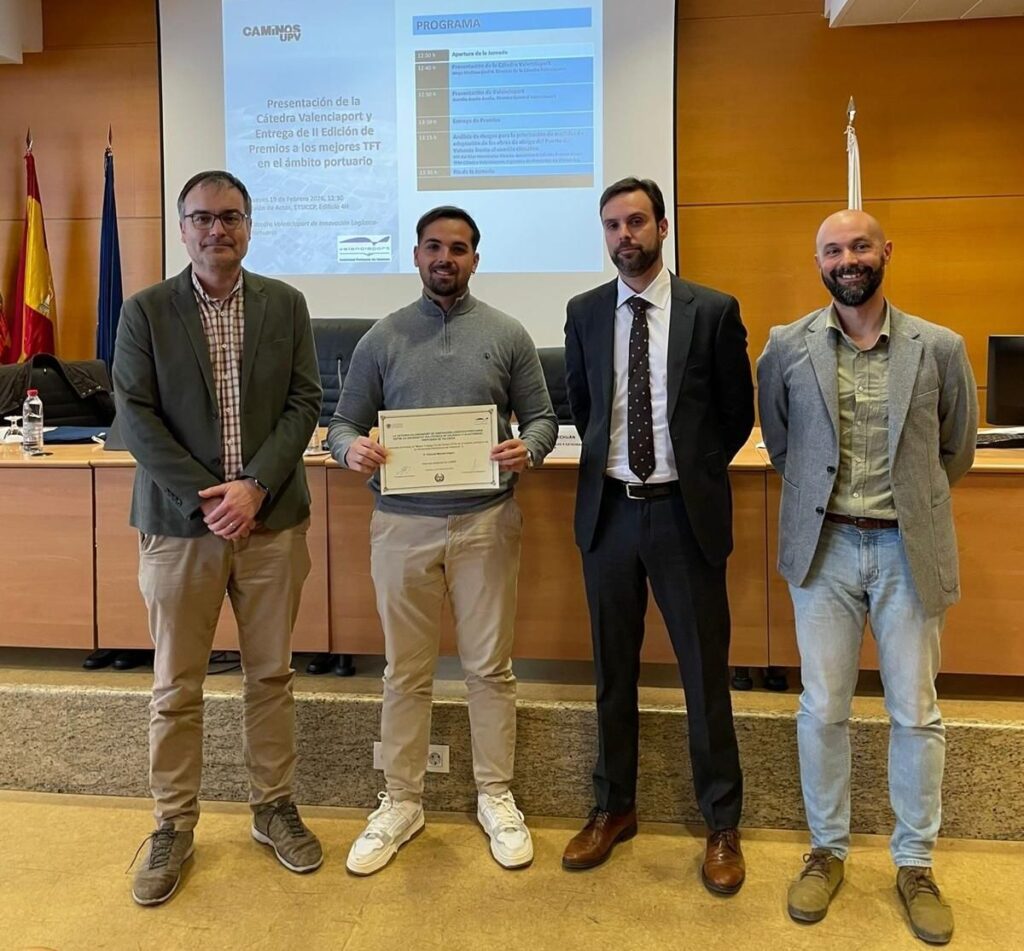
The winners of this second edition were María del Mar Hernández Vicedo and Pascual Morant Alegre. The former was recognized as the Best Final Degree Project (TFG), while the latter received the award for Best Master’s Thesis (TFM). Both are recognized for addressing issues of interest in the logistics and port sector, such as energy transition, resilience to climate change in the port sector, digitization, and innovation, among others.
Climate change and improvement of facilities in Gandia
In this context, María del Mar Hernández Vicedo’s work focuses on risk analysis for prioritizing adaptation measures for the Port of Valencia’s protective structures in the face of climate change. To this end, she has studied the current state of the Port of Valencia’s protective structures and the possible future impacts caused by climate change.
The study examines the different stresses, failure modes, and consequences, differentiating each section of the breakwater that makes up the port. The objective of the analysis is to provide a support tool for decision-making in future investment projects by the Port Authority, highlighting the most affected shelter works and their corresponding consequences. On the other hand, Pascual Morant Alegre’s work has studied solutions for the design and construction of the new breakwater at the Port of Gandia with the aim of gaining space in this port. To this end, he analyses different possibilities for the construction of the breakwater, focusing on the shape, the different possible parts to be used, as well as where to store the materials, the cost, and its effects on the coast.